Sri Rampai, Wangsa Maju
Kuala Lumpur, Malaysia
adyaakob@gmail.com
+60 102369037
Sri Rampai, Wangsa Maju
Kuala Lumpur, Malaysia
adyaakob@gmail.com
+60 102369037

Imagine a world where AI isn’t just a buzzword but the very backbone of how we live, work, and solve big global problems.
That’s not science fiction—it’s the next 10 years.
This blog takes you on a ride through the 10-Year AI Roadmap (2025–2035). Think of it as your GPS to the future, covering everything from booming AI agents to ethical speed bumps, from personalized healthcare to quantum-powered problem solving.
Let’s break it down (without the corporate mumbo jumbo).
By 2025, AI is no longer a toddler. It’s doing grown-up things—writing, coding, chatting, designing, and even helping manage warehouses. Over 65% of companies are using generative AI in some way. Think of ChatGPT… but now imagine it running customer service, HR, and even your next ad campaign.
Models like OpenAI’s o1 can actually reason, not just regurgitate. It’s a shift from “parrot” to “problem solver.”
But here’s the twist: even with this rapid growth, only 1% of companies say they’ve fully integrated AI. We’re still in the early innings.
✅ Smarter reasoning: AI won’t just complete your sentence—it’ll challenge your business strategy (nicely).
✅ Multimodal inputs: Text + images + audio = richer conversations. Ask it something with your voice, show it a photo, and get a tailored response.
✅ Agentic AI: These are autonomous AIs that can execute tasks on your behalf—think AI assistants that can plan your trip, file your taxes, or manage logistics without hand-holding.
And guess what? This isn’t just cool tech. These advances could boost global GDP by 11% by 2030.
Behind every smart AI is a crazy-powerful machine. That’s where things get spicy:
✅ Custom chips (ASICs) are replacing generic GPUs. They’re faster and more energy-efficient.
✅ Memory optimization is the next big frontier. More memory = smarter, longer conversations.
✅ Power problems: AI needs a lot of electricity. Some companies are building their own power plants to keep up.
By late 2025, the conversation will shift from “how fast can we train this model?” to “how do we keep the lights on?”
Here’s how AI is quietly revolutionizing the world:
✅ Healthcare: Diagnosing diseases better than doctors, monitoring patients remotely, and customizing treatments.
✅ Finance: Smarter lending, real-time fraud detection, and AI-driven trading strategies.
✅ Manufacturing: Predicting when machines will fail before they fail.
✅ Retail: Personalized marketing, AI answering your questions, and zero-inventory waste.
✅ Agriculture: Precision farming. Less water, more yield.
By 2035, AI will be so embedded you’ll barely notice it—until you remember how slow and clunky things used to be.
✅ AI will replace 16% of jobs… but create 9% new ones.
✅ Admin-heavy sectors like banking may shrink.
✅ Creative, strategic, and people-focused roles? They’ll boom.
Governments will need to step up—offering reskilling programs, safety nets, and ways to match people with the jobs of tomorrow.
Still, the overall economic boost is worth it: AI could add $15.7 trillion to the global economy by 2030.
Let’s not forget the bigger picture:
✅ Climate: AI can predict wildfires, optimize solar/wind energy, and manage smart grids.
✅ Healthcare Access: Remote diagnostics for rural and aging populations.
✅ Education: AI tutors that level the playing field for low-performing students.
This is where AI becomes more than a productivity tool—it becomes a force for good.
With great power comes great responsibility:
✅ Bias: AI can reflect society’s prejudices. Developers must fix that.
✅ Privacy: More data = more risk. Governance frameworks like GDPR are crucial.
✅ Transparency: We need to understand how AI makes decisions, especially in sensitive areas like hiring or lending.
Expect more talk about “human-in-the-loop” systems, where AI assists but doesn’t completely replace human judgment.
The convergence of AI with other emerging tech is next level:
✅ Quantum AI: Quantum computers will solve problems traditional ones can’t—like supercharging drug discovery or optimizing global shipping routes.
✅ IoT + AI: Smart devices that don’t just collect data, but make real-time decisions. Think smart cities, smart hospitals, smart farms.
We’re talking about systems that learn, adapt, and act faster than ever before.
This is where AI goes full genius mode:
✅ Protein simulations? Months instead of decades.
✅ Climate modeling? More accurate, faster.
✅ Material discovery? New substances designed in days.
Scientists won’t be replaced—but they’ll be supercharged by AI “co-researchers.”
✅ Agentic AI goes mainstream
✅ Infrastructure booms (GPUs, chips, memory)
✅ Early regulations start to shape responsible use
✅ AI adoption explodes across all sectors
✅ Quantum AI finds its first real-world wins
✅ AI tackles social good—health, climate, education
✅ Near-total AI adoption in both big and small firms
✅ Deep automation, new industries born
✅ AI is no longer a tool—it’s a partner
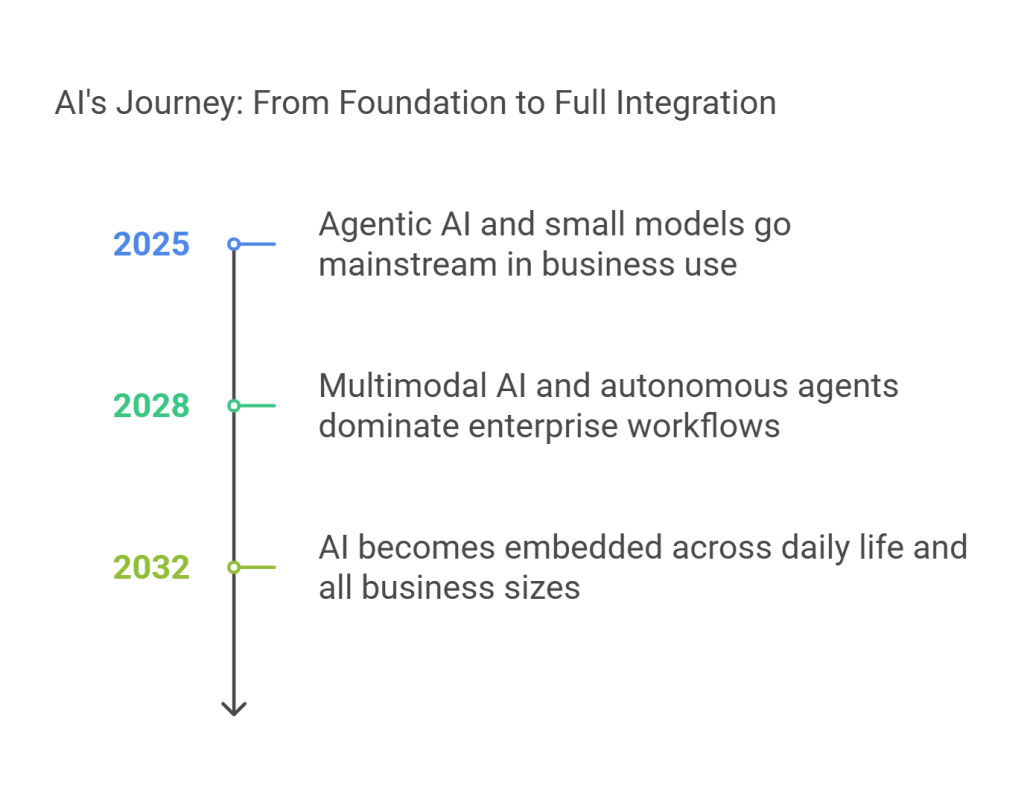
By 2035, AI will be:
✅ Embedded in daily life
✅ A driver of GDP growth
✅ A solver of climate, health, and education issues
✅ A collaborator—not a replacement—for human creativity and decision-making
The winners in this AI revolution? Those who embrace it boldly and responsibly.
Because in the end, the best kind of AI doesn’t replace us—it amplifies us.
Stay curious. Stay human.